
Past Exhibitions Archive
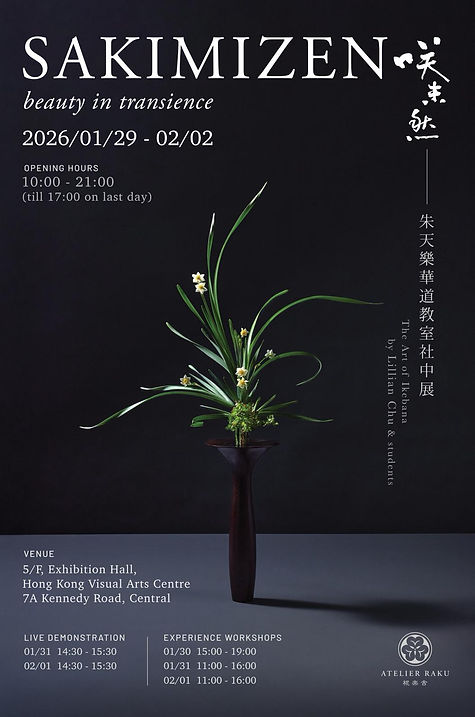
Exhibition Facts
Title:
SAKIMIZEN beauty in transience
The Art of Ikebana by Lillian Chu and students
咲未然 朱天樂華道教室社中展
Organized by:
ATELIER RAKU 椛楽舎
Curator:
Lillian Chu
Dates:
29 January, 2026 – 2 February, 2026
Opening Hours:
10:00 – 21:00 (Last day until 17:00)
Venue:
5/F Exhibition Hall, Hong Kong Visual Arts Centre
7A Kennedy Road, Central, Hong Kong
Visitors:
968 visits recorded across five exhibition days,
based on official venue head count.

Overview
SAKIMIZEN — beauty in transience was a public ikebana exhibition by Lillian Chu and students, presented at the Hong Kong Visual Arts Centre. The exhibition brought together approximately 16 photographic works and 38 live ikebana works, forming a multi-part presentation that moved between installation, observation, and public encounter. Centred on the interval before blooming or falling — a state of “unopened, unfallen” — the exhibition approached ikebana not simply as floral display, but as a way of attending to time, material change, perception, and stillness. The exhibition was self-funded and realised through the coordinated efforts of ATELIER RAKU and its exhibiting students.

Exhibition Statement
Thank you for joining us at SAKIMIZEN, and for witnessing years of growth in our shared ikebana journey.
The human heart naturally seeks beauty. Yet today, even as ikebana feels more accessible than ever, it also invites us to pause in the rush: how do we find inner stillness in a world that never stops?
Ikebana is a living art, quietly in motion. Once cut, flowers must wither, yet in that delicate pause — not yet opened, not yet fallen — their beauty feels most acute. To cherish this fleeting beauty is one way of responding to impermanence.
Beyond each arrangement’s visible form, we hope visitors may sense what cannot be seen: the gentle current of time, the quiet breath of living materials, and the spaciousness that appears when the mind comes to rest.
This practice, and the chance to share it publicly, owes much to the steady support of family, friends, and students. We hope SAKIMIZEN leaves a small lingering resonance — a trace of that tender moment of “unopened, unfallen”.

Public Programmes
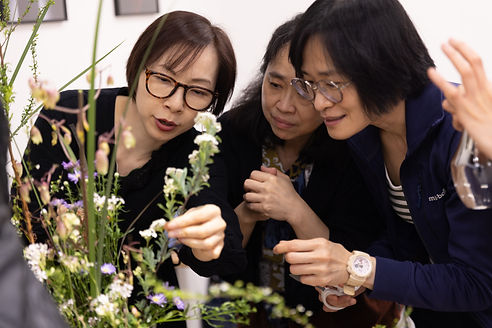
The exhibition was accompanied by guided tours, live demonstrations, and hands-on workshops, allowing visitors to encounter ikebana not only as a finished display but also as an active and time-based practice.
Live Demonstrations
Two live demonstration sessions were held on 31 January and 1 February 2026, each drawing approximately 150 attendees, with audience numbers shaped by the physical capacity of the venue.


Public Engagement
968
visits recorded across five exhibition days at Hong Kong Visual Arts Centre.
160
minutes of live ikebana demonstration, shared across two public sessions, each drawing 150 attendees within the venue’s capacity.
42
participants in hands-on ikebana workshops over three days, creating their own works to take home.
5
days of exhibition activity, with student-led guided tours and on-site hosting throughout opening hours.
Installation Views
Selected installation views from the exhibition. These photographs document the exhibition environment, the spatial relationship between works, and the atmosphere of public viewing across the five-day presentation.


Visitor Response
The observations below are drawn from informal conversations with visitors during and after the exhibition, and are presented here as response themes rather than verbatim testimonials.
-
Audience responses often suggested that the exhibition expanded familiar assumptions about ikebana, presenting it not only as visual beauty but also as a way of attending to time, space, and living material.
-
Many visitors responded to the unusual quietness of the installation environment and the sense that the works invited slower, more concentrated looking.
-
A recurring theme in informal feedback concerned the balance between fragility and structure: the works appeared delicate, yet were experienced as highly intentional and carefully resolved.
-
Across five exhibition days, the venue recorded 968 visits. The two live demonstration sessions each drew approximately 150 attendees within the physical limits of the space, and around 42 participants took part in hands-on workshops over three days, learning basic ikebana principles and creating their own works to bring home.
Afterword
SAKIMIZEN unfolded through a sequence of reflections on beauty, transience, fracture, coexistence, and what may linger beyond visible form. Across the exhibition, ikebana was approached not only as arrangement, but as a way of perceiving how life moves through opening, fading, loss, renewal, and quiet continuation.
Informal conversations with visitors suggested that many encountered ikebana here for the first time not simply as floral display, but as a spatial and contemplative practice shaped by tension, interval, and impermanence. That exchange — between works, space, and viewers — became an important part of the exhibition’s meaning.
Although the exhibition has come to a close, the dialogue it opened continues through ATELIER RAKU’s ongoing courses, workshops, and future projects. In this sense, SAKIMIZEN remains not only a concluded event, but part of a longer practice of looking, arranging, and living with greater attention.
Credits
Exhibitors:
朱天樂 Lillian Chu
符詩敏 Vienna Fu
梁添偉 Gerriet Leong
王潔宜 Cherry Wong
王純純 Sara Wang
劉苑清 Loretta Lau
梁穎姿 Gigi Leung
陳美芝 Maggie Chan
陳曉恩 Yanki Chan
謝秀嫻 Jenny Tse
卞蓉琤 Wendy Bien
施愷茵 Vivian See
鍾啟文 Edmond Chung
浜口愛子Aiko Hamaguchi
顧崇熙 Fenris Kau
鄧 娟 Spancer Tang
Curatorial & Organization
Organized by: ATELIER RAKU
Curator: Lillian Chu
Exhibition Coordinator: Gigi Leung, Cherry Wong
Design & Production
Graphic Design: Jack Tung
Poster Design: Fenris Kau
Exhibition Setup: Annebell Chan
Photography: Tung
Calligraphy: Brian Li
About ATELIER RAKU 椛楽舎
For over six years, ATELIER RAKU has explored the art of living through flowers.
“椛”, Japanese for maple, echoes with “ka” (flower), honouring our root in the tradition of kado while marking the turning of seasons and the phases of life. “楽”, borrowed from the founder’s name, evokes the quiet joy of creation — a small urban retreat where one can be surrounded by plants and immerse fully in the meditative process of ikebana.
Kado, to us, is more than a hobby; it is a way of life. Through plants, we sharpen our eye for beauty, gently reshape how we see ourselves and our world, and let calm, clarity, and purpose fill our days.
We offer certificate courses and workshops, from beginner to advanced, guiding each participant to discover their own rhythm through flowers and reconnect with inner peace. Slow down between bloom and empty space — living gracefully through change.
